The Complete Guide to Abdominoplasty: Restoring Your Ideal Figure and Getting Rid of Sagging Skin After Pregnancy and Weight Loss 🌟
Surgical abdominoplasty, scientifically known as abdominoplasty, is a procedure that involves lifting the abdomen during pregnancy.Abdominoplasty**, one of the most requested and impactful cosmetic procedures in the field of surgery cosmetic. It is not just a fat removal procedure; it is a precise surgical intervention aimed at treating three key components that contribute to abdominal sagging and loss of its toned shape: **excess skin, accumulated fat, and weakened abdominal wall muscles**.
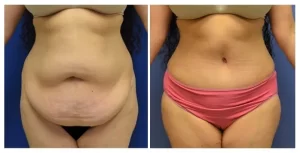
A tummy tuck is a popular and effective solution for people with stubborn abdominal sagging, which often results from significant weight loss (such as after bariatric surgery like gastric sleeve), as a natural and expected side effect of repeated pregnancies, or simply as a result of natural aging and loss of skin elasticity. This sagging and excess skin typically does not respond to diet or exercise, no matter how intense, making a surgical tummy tuck the only procedure capable of restoring a flat, toned, and proportionate figure.
The aim of this article is to provide a **comprehensive and detailed guide** about **surgical abdominoplasty**, starting with its goals and types, moving through the precise surgical steps, and ending with the recovery period and potential risks, to help those wishing to undergo the procedure make an informed decision.
Goals and advantages of abdominal tummy tuck surgery (Abdominoplasty)
The goals of a surgical tummy tuck go beyond simply removing fat. It is a profound reconstructive and cosmetic procedure that directly affects bodily functions and aesthetic appearance. The main goals and benefits can be summarized as follows:
1. Removal of excess skin and stubborn sagging
This surgery helps remove excess skin that can only be eliminated surgically, especially loose skin in the lower abdomen. Excess skin after significant weight loss or pregnancy permanently loses its elasticity, creating both an aesthetic and functional problem. The surgeon removes this skin completely to ensure a smooth and toned abdominal surface.
2. Tightening and repairing abdominal wall muscles (Diastasis Recti Repair)
This goal is of paramount importance and functionality, especially for women after pregnancy. The rectus abdominis muscles are prone to separation or sagging, a condition known as diastasis recti. During a tummy tuck, the surgeon tightens the weakened abdominal muscles, repositions them, and sutures them closed, resulting in:
- Improving functional support for the spine.
- Correcting the appearance of a “bloated belly” or “potbelly” caused by muscle weakness.
- It effectively narrows the waistline.
3. Improve aesthetic appearance and body symmetry
The end result of a surgical tummy tuck is a flat, toned abdomen and a sculpted waist. This aesthetic improvement significantly boosts self-confidence and enhances clothing choices, making it a true investment in the patient's quality of life.
4. Correction of localized stretch marks
Although a tummy tuck is not a cure for stretch marks in general, the surgical incision, usually made in the lower abdomen, allows for the removal of the bulk of the sagging skin that often bears the stretch marks located below the navel, thus visibly reducing their appearance.
5. Removal of excess localized fat
In conjunction with skin tightening, liposuction is often performed on the abdomen and flanks. This combined procedure allows for waist contouring and the removal of localized fat deposits that do not respond to diet, ensuring a smoother and more harmonious transition between the abdomen and hips.
Types of surgical tummy tucks: Choosing the most suitable technique
There is no single type of abdominoplasty (tummy tuck) that suits all cases. The surgeon determines the most appropriate technique based on the degree of sagging, the amount of excess skin, and its location. The main types are:
1. Full Abdominoplasty
This is the standard and most common procedure, and is used when there is **significant sagging** of skin and fat extending from under the breasts to the pubic area, with **clear separation of the abdominal muscles**.
- Surgical incision: A long horizontal incision extending from one hip bone to the other hip bone in the bikini line area, plus an incision around the navel to reposition it.
- Procedure: Tighten the abdominal muscles completely (above and below the navel), remove as much skin and fat as possible, and move the navel to its new position.
2. Mini Abdominoplasty
This type is suitable for people who have **mild** localized sagging that is concentrated only in the **lower** part of the abdomen (below the navel) and do not need to tighten the muscles above the navel.
- Surgical incision: A horizontal incision is much shorter than a full incision (about 10-20 cm), and does not usually require an incision around the navel or its relocation.
- Procedure: Excess skin and fat below the navel may be removed, and the muscles in that area may be tightened only.
- Advantages: Smaller scar, shorter recovery period.
3. Circumferential Abdominoplasty
It is also known as a lower body lift. It is ideal for patients who have experienced significant weight loss (e.g., after gastric sleeve surgery) and who have loose skin on their abdomen, back, and buttocks.
- Surgical incision: It completely encircles the body (360 degrees) around the waist.
- Procedure: It combines a full abdominal tightening with tightening of the back, sides, and buttocks, resulting in an overall improvement in body contour.
4. Reverse Abdominoplasty
It is rarely used in cases of severe sagging in the upper abdomen (above the navel), and the incision is directly under the breast.
Detailed steps of the surgical tummy tuck procedure (standard technique)
A full tummy tuck typically takes between two and five hours and is performed in a safe surgical environment under the supervision of an anesthesiologist and a surgeon. The main steps are:
1. Anesthesia and preparation
- Anesthesia: General anesthesia is most often used to ensure the patient's complete comfort and absence of pain throughout the procedure. In very rare cases, or for a mini tummy tuck, local anesthesia with intravenous sedation may be used.
- Sterilization: The entire abdominal area is sterilized and covered with sterile sheets.
2. Surgical incision
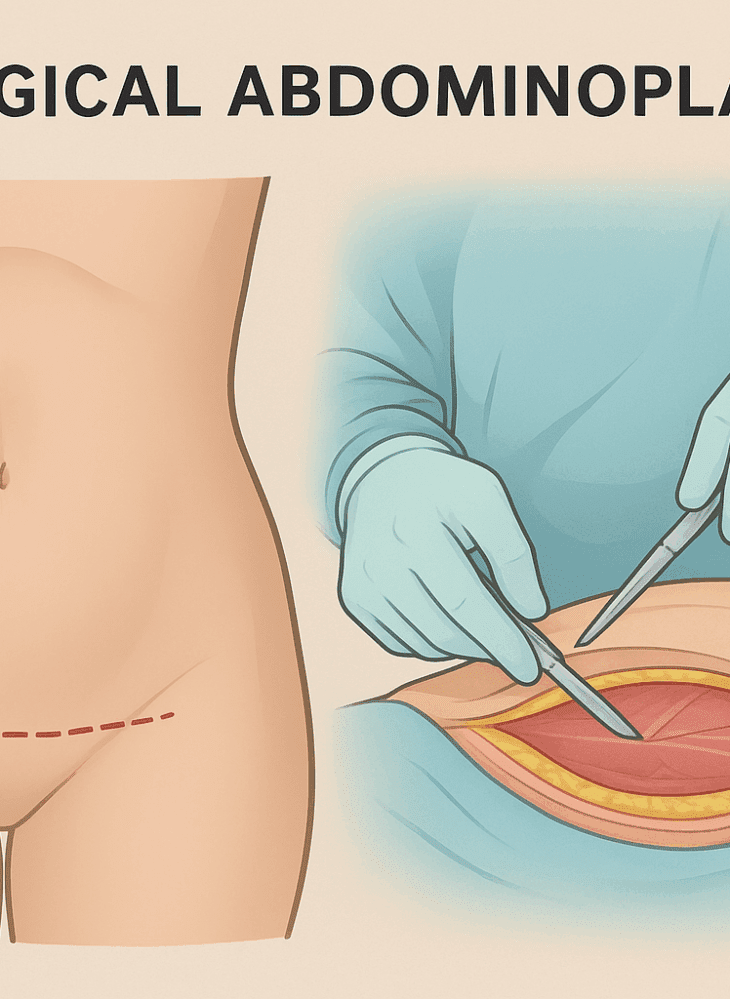
The surgeon creates a major horizontal incision that runs from hip to hip, placed very low (usually below the bikini line) so that it can be concealed by underwear or a swimsuit. An incision is also made around the navel to free it from the surrounding skin, while it remains attached to its original position on the abdominal wall.
3. Separating skin and fat and tightening muscles
- Skin separation: The layer of skin and fat overlying the abdominal muscles is gently separated and lifted towards the chest.
- Muscle tension (Plication): The surgeon tightens the separated abdominal muscles (diastasis recti) and repositions them along the midline, suturing them with permanent or semi-permanent stitches. This procedure gives the abdomen its flat, toned shape and supports the waist.
4. Removing excess skin and defining the navel
The separated skin and fat are pulled firmly downwards, and then the excess skin that hangs beyond the original incision line is identified and removed. A new navel opening is then created in its proper new position on the stretched skin.
5. Closure and drainage
The surgical incisions are closed with meticulous care using multi-layered sutures to minimize strain on the scar and ensure proper healing. Drains are often placed under the skin for several days to prevent fluid buildup (seroma), which is crucial for reducing complications and accelerating recovery.
Integrated liposuction: Most often, liposuction of the flanks and sides is performed before a tummy tuck to enhance waist definition and ensure body contouring.
Who are the ideal candidates for a tummy tuck?
Deciding to undergo a surgical tummy tuck requires a thorough assessment of the patient's health and realistic expectations. Ideal candidates are:
1. People with a stable weight and good health
- Stable weight: The patient must have reached a healthy and stable weight at least six months before surgery. Large weight fluctuations after the procedure may compromise the results.
- public health: The patient should be in good health in general and not suffer from uncontrolled chronic diseases (such as severe diabetes or heart disease).
2. Cases of obvious sagging
- Post-pregnancy sagging: Women who have completed their reproductive plans and have noticeable sagging skin and weakness or separation of the abdominal muscles (Diastasis Recti).
- Sagging skin after weight loss: People who have lost large amounts of weight and have excess, sagging skin (sometimes hanging in an apron shape).
3. Realistic expectations and healthy habits
- Quit smoking: The patient must be a non-smoker, or able to quit smoking completely for at least 4-6 weeks before and after surgery. Smoking severely impairs wound healing and increases the risk of complications.
- Self-motivation: The motivation for the procedure should stem from a personal desire to improve one's appearance, and not to please another party.
Important note: **A tummy tuck is not a weight loss procedure.** If the goal is to get rid of a lot of fat, you should first try to lose weight or consider bariatric surgery.
Recovery and care after a tummy tuck: A detailed guide
The recovery period is a vital part of the success of a tummy tuck. Adhering to medical instructions ensures minimal risk and optimal aesthetic results.
1. Initial recovery period (first two weeks)
- Length of stay in the hospital: The procedure may require a one-night or two-day hospital stay for monitoring and pain management.
- Pain and swelling: Pain, swelling, and bruising are very common and are managed with prescribed painkillers. Swelling may last for weeks or even months.
- Drainage pipes: Drains are usually placed for 3-7 days and are removed when fluid secretion decreases to a certain level.
- Sleeping and movement position: The patient should walk slowly and in a slightly bent position (arching of the back) for about a week to reduce strain on the suture line, and it is preferable to sleep in a semi-sitting position.
2. Compression clothing (support belt)
Wearing an abdominal binder or compression garment is essential. It should be worn continuously (24 hours a day) for 4 to 6 weeks. Benefits of the binder:
- Reduce swelling and edema.
- Support for newly toned muscles.
- Improve the final texture.
3. Return to activities
- Returning to work: Most patients need **two to three weeks** to recover before returning to office work.
- Leadership: Often after 2-3 weeks, after stopping the strong painkillers.
- Strenuous exercise: Strenuous exercise, weightlifting, and any activity that strains the abdominal muscles should be avoided for at least 6 weeks or as directed by the surgeon.
Final results: Although initial results appear immediately, final results, scar stabilization, and disappearance of swelling may take from 6 months to a full year.
Potential risks and complications of tummy tuck
As with any major surgical procedure, a surgical tummy tuck carries some risks and potential complications. Choosing a qualified surgeon and the patient's adherence to post-operative instructions greatly reduces these risks.
1. The most common complications
- Fluid accumulation (Seroma): This is an accumulation of serous fluid under the skin. It is prevented by using drainage tubes, and if it occurs, it may require needle aspiration by a doctor.
- Infection: It may occur at the site of the incision. It is treated with antibiotics.
- Bleeding and hematoma formation: Blood accumulating under the skin may require minor surgical intervention to remove it.
- Wound healing problems: Especially among smokers or diabetics.
2. Aesthetic and functional complications
- Scars: There will be a permanent scar, but it will be placed low in the skin to conceal it. The scar may take a long time to fade or may require additional treatment (such as laser or scar creams).
- Numbness: It is common in the abdominal area after surgery due to the severing of superficial nerves. It usually resolves or improves gradually over several months to a year.
- Change in the shape of the navel: The shape of the navel after transplantation may not be completely normal (Umbilical Distortion).
3. Rare and serious complications
- Deep vein thrombosis (DVT): There is a risk of blood clots forming in the legs, which may travel to the lungs (pulmonary embolism). This risk is reduced by early mobilization after surgery and the use of compression devices.
- Skin necrosis: Death of a portion of the skin due to impaired blood flow. Rare and occurs more often in smokers.
In conclusion: Abdominoplasty as an investment in quality of life
Surgical tummy tuck (Abdominoplasty) It is a transformative procedure that delivers results unattainable through exercise or diet alone, especially in cases of severe sagging and diastasis recti following pregnancy or weight loss. It not only improves appearance but also restores strength and functional support to the core muscles.
Deciding to undergo a tummy tuck is a significant investment in self-confidence and patient comfort. Thanks to advanced surgical techniques (such as combined liposuction), surgeons can now sculpt a toned and contoured physique that goes beyond simply removing skin. With proper recovery and aftercare, patients can enjoy a flat stomach and a more defined figure that enhances their quality of life and body image for many years to come.
To ensure the best results and the safety of the procedure, you should always look for a certified plastic surgeon with extensive experience in **tummy tucks** and dealing with complex sagging cases.